Termite control stabilizes residential structures against active infestations without exposing living spaces to unnecessary broad-spectrum chemicals. In historic Richland County neighborhoods like Shandon, Cottontown,…
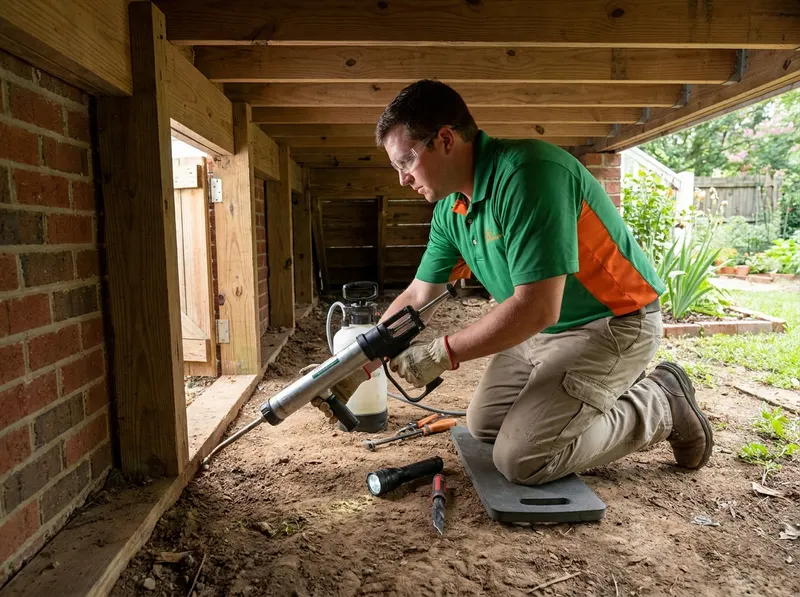
Termite control stabilizes residential structures against active infestations without exposing living spaces to unnecessary broad-spectrum chemicals. In historic Richland County neighborhoods like Shandon, Cottontown, and Elmwood Park, historic homes frequently sit on raised brick piers with vented crawl spaces. High relative humidity and direct earth-to-wood ground contact create ideal transit points for Eastern subterranean termites, which construct mud tubes over masonry to reach floor joists. Conversely, slab-on-grade builds in Forest Acres, Heathwood, and Lake Katherine face subterranean entry along interior plumbing penetrations and expansion joints concealed beneath finished flooring.
Selecting a treatment approach depends on foundation mechanics and soil saturation levels. Non-repellent liquid soil barriers (such as fipronil applied at 4 gallons per 10 linear feet into perimeter trenches) establish continuous zones that foraging termites transfer back to the central nesting colony. This method fits homes with accessible exterior soil, though clay-dense soils common around Rosewood and Old Shandon require rod injection to achieve proper depth. For properties bordering waterways or dense landscape beds, baiting systems installed every 10 to 12 feet provide an environmentally contained alternative by intercepting subterranean workers via chitin synthesis inhibitors, bypassing broad soil saturation entirely.
Structural protection operates in clear steps to eliminate colony pressure. Step 1: Technicians probe foundation perimeter sills, crawl space support timbers, and interior baseboards to map live galleries and moisture anomalies. Step 2: The foundation boundary is prepped through continuous trenching or precision drilling along attached concrete patios. Step 3: Low-impact formulations or monitored bait arrays are applied directly to entry pathways. Step 4: Follow-up moisture monitoring and annual surface re-examinations ensure subterranean access points remain inactive across seasonal spring swarming events.
Every job gets a firm, written price after a free on-site visit.
Tell us about your termite control job in Columbia and we'll send a clear, written quote, usually the same day.
 Orelvo Pest Care