Residential stinging insect pressure accelerates rapidly in Richland County between April and October, when ambient humidity and extended heat cycles allow colonies to expand from single queens into populations…
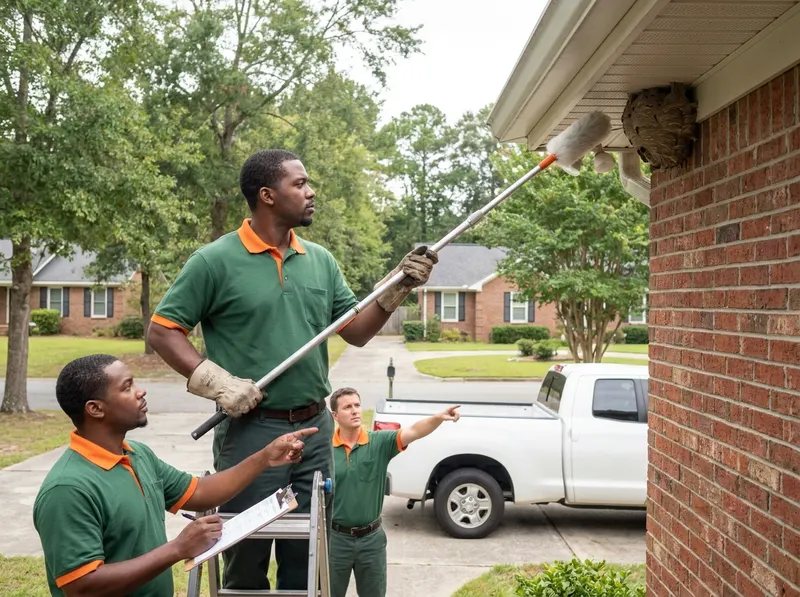
Residential stinging insect pressure accelerates rapidly in Richland County between April and October, when ambient humidity and extended heat cycles allow colonies to expand from single queens into populations exceeding 3,000 workers. In historic neighborhoods like Shandon, Cottontown, and Elmwood Park, aged rooflines, open soffits, and crawlspace vents provide protected voids for European hornets and paper wasps. Properties in Forest Acres and Lake Katherine frequently encounter subterranean eastern yellow jacket colonies established in abandoned rodent burrows or along root systems near landscaped irrigation lines. Immediate containment prevents aggressive defensive swarms that pose direct venom-allergen risks to household members and domestic pets sharing active yard spaces.
Effective colony eradication balances immediate containment against structural substrate preservation. Aerial paper wasp nests positioned under the porch fascia of an Earlewood craftsman home call for localized aerosolized pyrethrin applications coupled with mechanical scraper detachment, preventing cosmetic staining on historic millwork. In contrast, subterranean yellow jacket cavities common along sandy residential plots in Rosewood and Heathwood require targeted pressurized dust formulations that permeate the brood chambers without broad-spectrum chemical saturation across surrounding turf. Ground applications resolve active colonies within 24 hours, whereas aerosolized contact formulations achieve physical knockdown in under 30 minutes, avoiding the recurring settlement that untreated voids encourage.
Homeowners weighing single-nest removal against ongoing seasonal suppression must consider property boundary density and canopy cover. A single physical extraction suits isolated wall-void infestations discovered during exterior painting or gutter cleanouts, presenting lower initial expenditures. Heavily treed lots border areas near Columbia Canal and Riverfront Park or Finlay Park experience continuous re-infestation pressure from fertile queens searching for overwintering sites each autumn; such properties benefit from seasonal perimeter repellent applications to exposed eaves and deck framing. Technicians evaluate the surrounding tree line, confirm the colony genus, and supply an exact on-site figure before starting treatment.
Every job gets a firm, written price after a free on-site visit.
Tell us about your stinging insect control job in Columbia and we'll send a clear, written quote, usually the same day.
 Orelvo Pest Care